

IKON SKILLS™
Architect of Education: IKON SKILLS™ and Proof of Practical Skill
7 November 2026 · Hon. Ky. Col. Prof. Dr. Edward Roy Krishnan
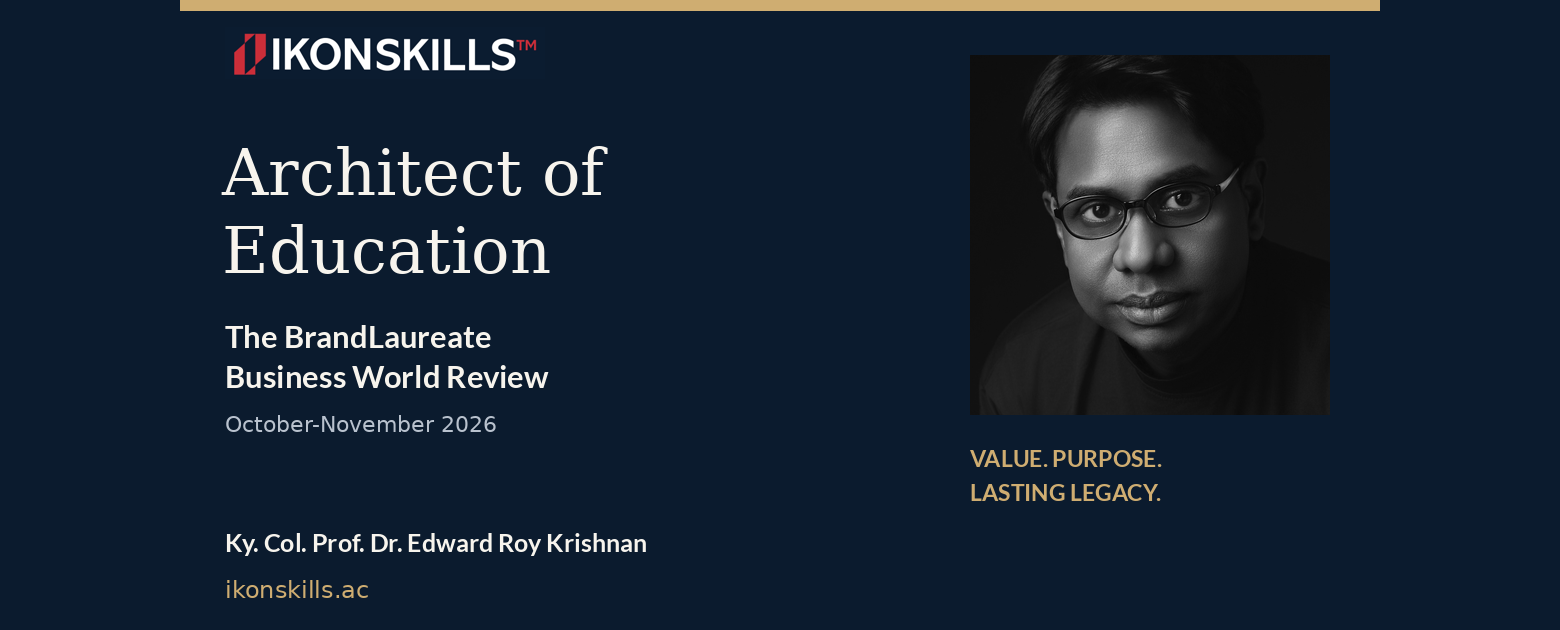
Quick answer: For IKON SKILLS™, an Architect of Education builds a Learning Journey around what people can actually do. Our founder, Ky. Col. Prof. Dr. Edward Roy Krishnan, is featured in The BrandLaureate Business World Review. We mark that moment by returning to our practical purpose: learning that changes behavior and creates real value.
His role is Founder & Creator of IKON SKILLS™ at www.ikonskills.com. The title Architect of Education is meaningful to our community because it raises a direct question: what changes when someone completes a Learning Journey? A stronger vocabulary is useful, but the deeper test is whether a person can act with greater capability and judgment.
Read the feature in The BrandLaureate Business World Review, October-November 2026.
Learning means a change in behavior
Our position is simple: learning = change in behavior = DOING. The person must move beyond recognizing an idea to using it. That shift gives educational design a practical direction. Start with the action that matters, then ask what understanding, practice and reflection make that action possible.
This is not an argument against knowledge. Knowledge becomes more valuable when it guides a decision, improves an output or helps someone handle a real problem. Practical skill joins understanding with action, rather than treating the two as separate achievements.
What do Practitioners actually do?
Practitioners analyze a situation. They identify the problem, examine relevant information and question assumptions. They design a response, create an output and explain why they chose that approach. They test, review and improve. These action verbs make the intended change visible.
Consider a simple workplace example, not a promise about a particular Micro-Credential. Someone asked to improve a handover might map the current process, identify missing information, draft a clearer checklist and test it with colleagues. The useful evidence is not merely an explanation of why handovers matter. It is the quality of the response and the reasoning behind it.
That distinction helps people ask better questions about their own development. What can I demonstrate? What would good work look like in this setting? What needs to improve? A Learning Journey becomes more purposeful when these questions guide participation from the start.
Why Proof of Practical Skill matters
Proof of Practical Skill (PPS™) expresses the importance of demonstrable capability. It directs attention toward evidence of doing rather than relying only on the appearance of completion. The point is not to collect another badge without a meaningful change behind it.
Evidence should help someone explain what they did, how they approached it and what they would improve. It gives the Practitioner a more concrete basis for reflection. It also keeps the educational conversation close to useful action, where understanding can be examined rather than merely asserted.
Value first, commercial sustainability in service
Education requires resources and responsible planning. Financial sustainability helps a mission continue. But pursuing revenue is not the same as creating educational value, and the first must never be allowed to replace the second.
IKON SKILLS™ is not being built to reproduce a carbon-copy offer because education looks like an attractive market. The purpose is to support practical capability. That means keeping attention on the Practitioner, on meaningful action and on the value carried into work and life.
This is a statement of our own direction, not a judgment about every other provider. We want our choices to be understood clearly: purpose leads, resources support it, and legacy is measured in the contribution people can make afterward.
A shared recognition, built by community
No education architect builds alone. Practitioners bring effort and experience. Practitioner-learners ask questions that expose gaps and sharpen understanding. Partners connect ideas with practical needs. Patrons support the possibility of building for the long term. Colleagues turn purpose into consistent work.
To all of them, and to the entire EIU-Paris and IKON SKILLS™ community: thank you. Without you, we are nowhere. We also thank The BrandLaureate for featuring our founder and creating this opportunity to share the purpose behind the work.
The most meaningful response to recognition is continued commitment. Keep the Learning Journey grounded in action. Keep value ahead of appearances. Keep asking what a person can do differently, and why that difference matters.
Key takeaways
- Practical learning connects understanding with a change in behavior.
- Practitioners analyze, design, create, test, explain and improve.
- PPS™ keeps attention on evidence of practical capability.
- Community, value and lasting contribution give the mission its purpose.
Frequently asked questions
Who founded and created IKON SKILLS™?
Ky. Col. Prof. Dr. Edward Roy Krishnan is Founder & Creator of IKON SKILLS™ at www.ikonskills.com.
What does PPS™ stand for?
PPS™ stands for Proof of Practical Skill. Here, it describes the focus on demonstrating capability through doing.
Where can I read the Architect of Education feature?
Open the October-November 2026 magazine issue on Magzter. Reader access is subject to Magzter’s terms.
Explore a practical Learning Journey
Visit IKON SKILLS™ at www.ikonskills.com to explore the official information and consider what practical action you want to strengthen next.