

Blog
What Does a Business Data Analyst Do? Role, Skills & Career Path
7 September 2026 · Hon. Ky. Col. Prof. Dr. Edward Roy Krishnan
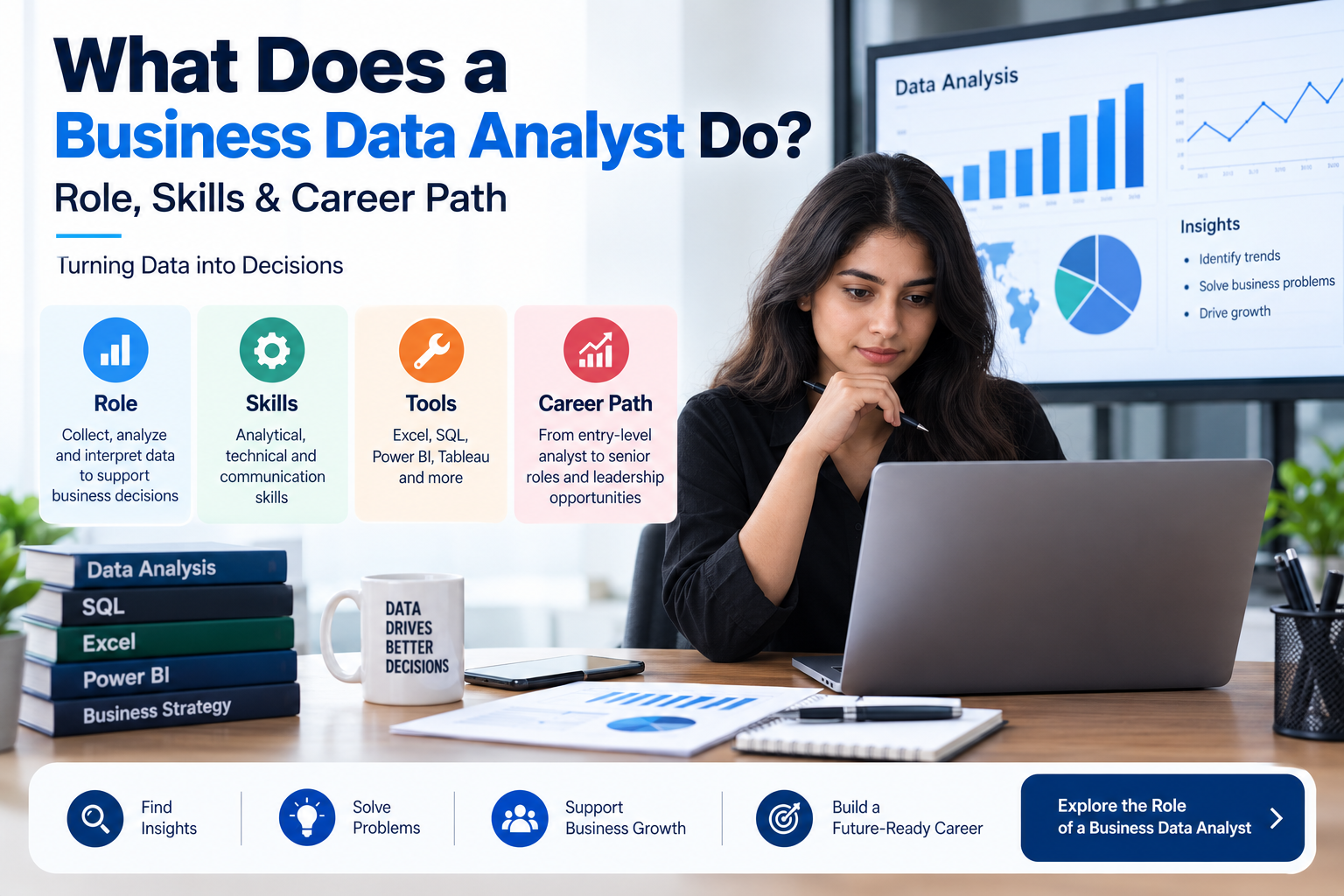
A Business Data Analyst collects, cleans and analyses business data, then turns it into clear insights that help managers make better decisions. They study sales, customers, marketing, operations and finance data, build reports and dashboards, find trends and problems, and explain what the numbers mean and what action the business should take.
Looking to advance your professional skills? Explore IKON SKILLS™ degree pathways to discover opportunities to progress your learning and career.
Table of Contents
- What are the key responsibilities of a Business Data Analyst?
- Which skills are important in business data analysis?
- How is a Business Data Analyst different from a Data Analyst?
- How is AI changing business data analysis?
- Is business data analysis a good career?
- What is the career path for a Business Data Analyst?
- How do you become a Business Data Analyst?
- Frequently Asked Questions
- Final Thoughts
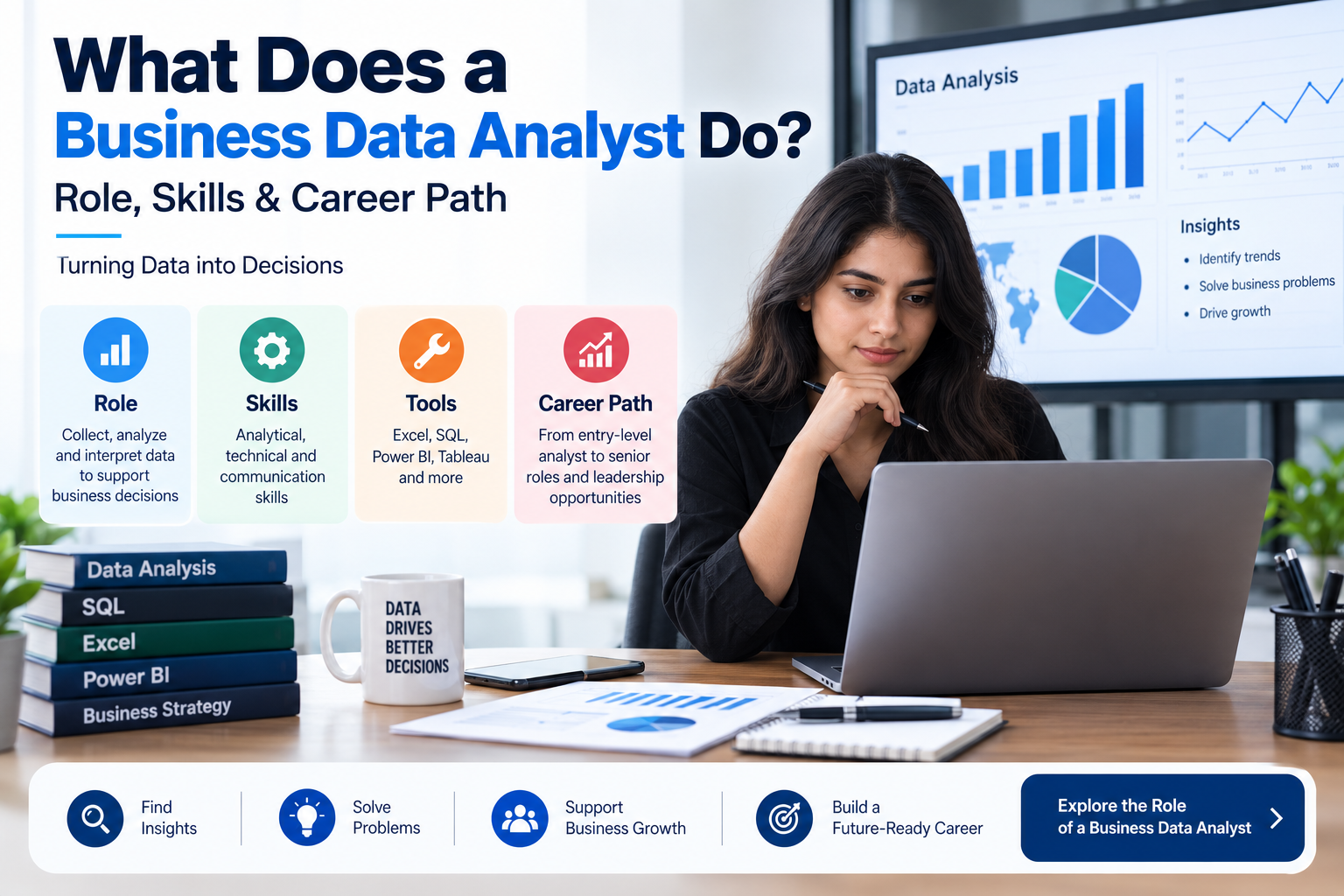
What are the key responsibilities of a Business Data Analyst?
– Understand the business question.
– Collect data from systems and databases.
– Clean and prepare data.
– Analyse trends, patterns and problems.
– Build reports and dashboards.
– Present findings and recommendations.
– Track the results of decisions.
Which skills are important in business data analysis?
– Business understanding.
– Excel and spreadsheets.
– SQL for data queries.
– Data visualisation (Power BI, Tableau).
– Basic statistics.
– Critical thinking.
– Clear communication and storytelling with data.
How is a Business Data Analyst different from a Data Analyst?
| Point | Business Data Analyst | Data Analyst |
| Focus | Business decisions and performance | Data analysis in many fields |
| Main users | Managers and business teams | Many teams, including technical |
| Typical work | KPIs, reports, recommendations | Analysis, models, data quality |
| Key strength | Linking data to business action | Depth of analysis |
How is AI changing business data analysis?
AI tools are increasingly used across the analysis workflow: cleaning data, writing queries, finding patterns and drafting summaries. The analyst still checks results, explains the business meaning and makes sure decisions use correct data. The World Economic Forum lists AI and big data as the fastest-growing skills up to 2030.
Is business data analysis a good career?
Demand for data skills is strong. For example, the U.S. Bureau of Labor Statistics projects 12% employment growth from 2025 to 2035 for operations research analysts, a related analytical job, much faster than average.
What is the career path for a Business Data Analyst?
Common next steps are senior analyst, business intelligence analyst, analytics manager, product analyst, analytics consultant and data strategy roles.
How do you become a Business Data Analyst?
1. Learn business basics and key metrics.
2. Learn Excel, SQL and one dashboard tool.
3. Learn basic statistics.
4. Build a portfolio of practical projects.
5. Practise explaining findings in simple words.
6. Prove your skill with the IKON SKILLS™ Business Data Analyst Micro-Credential: https://www.ikonskills.com/mc/business-data-analyst
Related reading: What Is a Data Literacy Professional? https://www.ikonskills.com/blog/what-is-a-data-literacy-professional-guide
About this IKON SKILLS™ Micro-Credential: Business Data Analyst
Page: https://www.ikonskills.com/mc/business-data-analyst
Domain: Data & Analytics
Level: EQF-aligned Level 6
Credit: 10 ECTS
Fee: USD 14.99
Structure: 10 Core Competencies
Assessment: the IKON Intelligence™ AI Competency Engine checks each Core Competency through a Final Scenario-Based Assessment. Only the Final Scenario-Based Assessment score counts. You can make unlimited attempts.
Result: Competent means a score of 75% or more. This is your Proof of Skill, not Proof of Attendance.
Endorsed by European International University (EIU-Paris)
Établissement d’Enseignement Supérieur Privé | UAI 0756213W
Next step: stack Micro-Credentials toward a degree. See https://www.ikonskills.com/emerging-degrees
Frequently Asked Questions
Q: What does a Business Data Analyst do?
A: Collects and analyses business data and turns it into clear insights for better decisions.
Q: Do Business Data Analysts need coding?
A: Basic SQL helps a lot. Python is useful but not always required.
Q: Which tools do they use?
A: Excel, SQL, Power BI, Tableau and sometimes Python.
Q: Is it a good career for beginners?
A: Yes. You can start with spreadsheets, SQL and a small portfolio.
Q: How is AI changing the role?
A: AI speeds up data work, but analysts still check results and explain the business meaning.
Q: What level is the IKON SKILLS™ Business Data Analyst Micro-Credential?
A: EQF-aligned Level 6, 10 ECTS, USD 14.99, in the Data & Analytics domain.
Final Thoughts
Skills matter most when you can prove them. IKON SKILLS™ Micro-Credentials give you Proof of Skill, not Proof of Attendance. Start with the matching Micro-Credential at https://www.ikonskills.com/mc/business-data-analyst and see how Micro-Credentials stack toward a degree at https://www.ikonskills.com/emerging-degrees
Read More : https://www.ikonskills.com/blog/what-is-an-ai-prompt-engineer