

Blog
What Is Strategic Thinking? How to Develop This Core Leadership Skill
7 September 2026 · Hon. Ky. Col. Prof. Dr. Edward Roy Krishnan
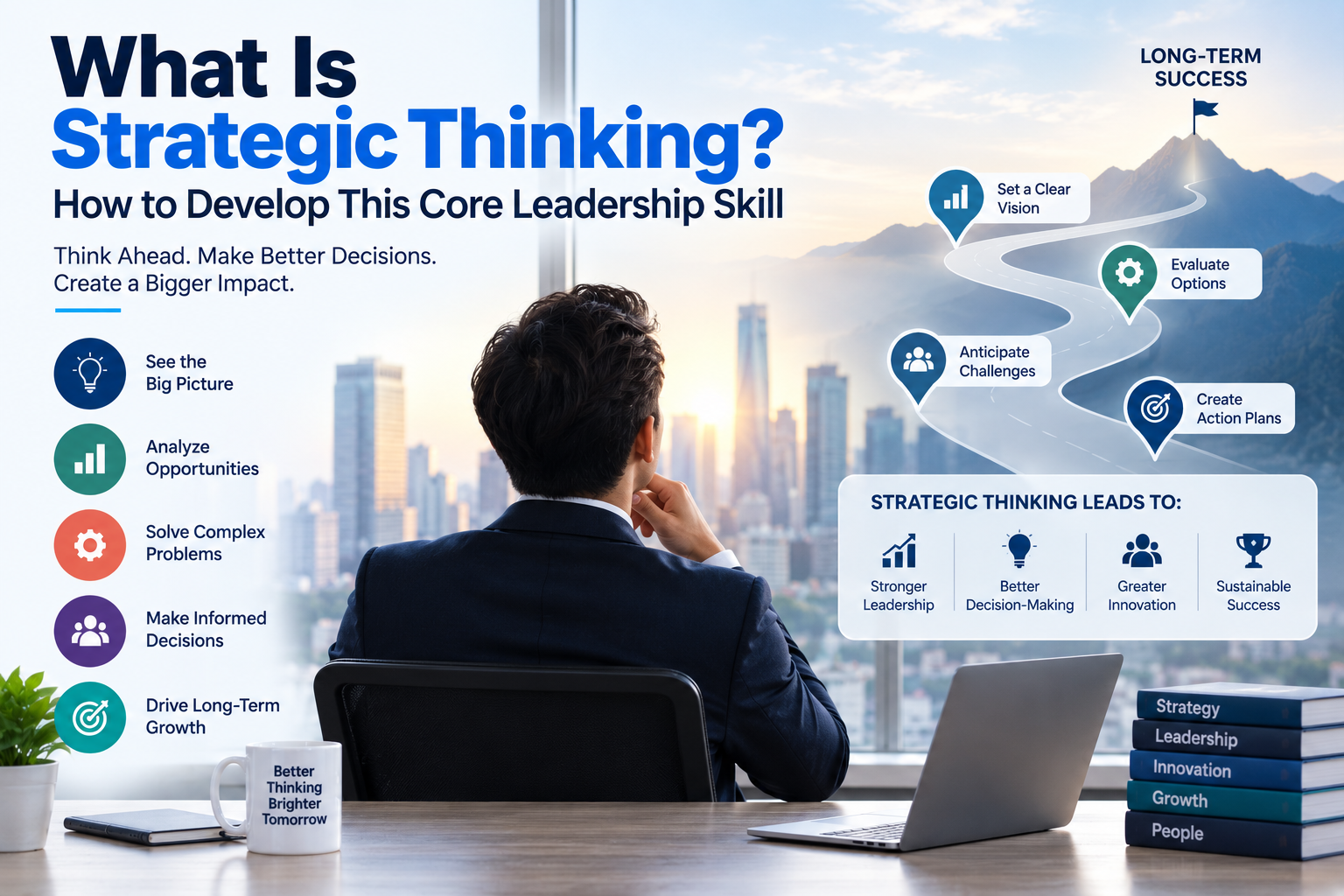
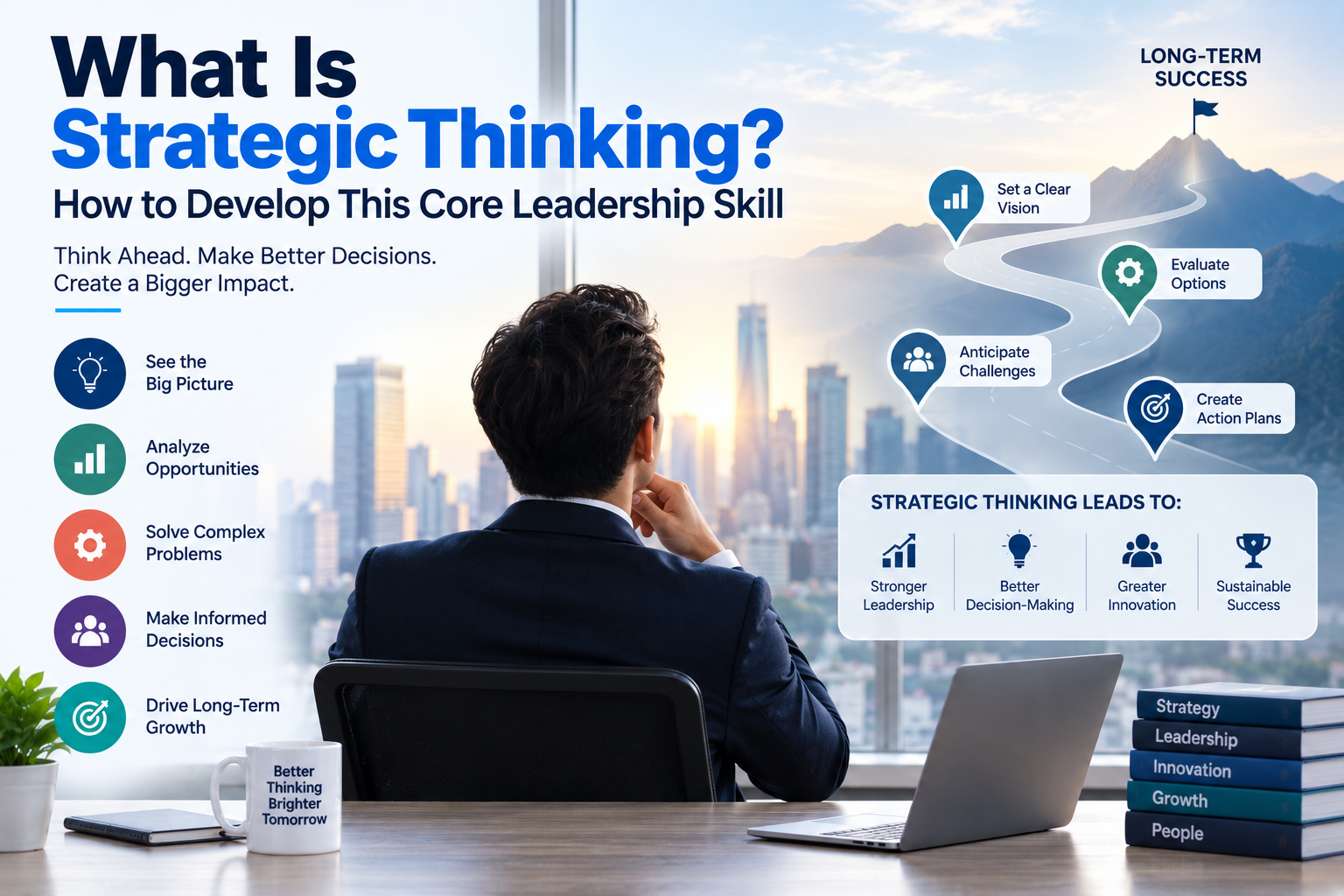
Strategic thinking is the ability to look beyond daily tasks, understand the bigger picture, compare different options and make choices that support long-term goals. It helps leaders connect today’s actions with future results, spot risks and opportunities early, and use limited time, money and people where they create the most value.
Looking to advance your professional skills? Explore IKON SKILLS™ degree pathways to discover opportunities to progress your learning and career.
Table of Contents
- Why is strategic thinking important?
- What are the key elements of strategic thinking?
- What does a Strategic Thinking Practitioner do?
- How is strategic thinking different from tactical thinking?
- How do you develop strategic thinking skills?
- What are common barriers to strategic thinking?
- How can you measure strategic thinking?
- Frequently Asked Questions
- Q: What is a Strategic Thinking Practitioner?
- Final Thoughts
Why is strategic thinking important?
Strategic thinking helps people and organizations make better long-term decisions, avoid wasting resources and prepare for change. The World Economic Forum reports that analytical thinking is the top core skill for employers, seen as essential by seven out of ten companies, and lists systems thinking among the rising skills.
What are the key elements of strategic thinking?
– Big-picture view: see how parts connect.
– Long-term focus: think in years, not only weeks.
– Option thinking: compare more than one path.
– Evidence: use data and facts.
– Priorities: choose what not to do.
– Adaptability: change the plan when facts change.
What does a Strategic Thinking Practitioner do?
A Strategic Thinking Practitioner applies these skills at work. They analyse situations, frame the real problem, build options, judge trade-offs, and help teams agree on clear priorities. They work in management, consulting, planning, policy and leadership roles. A related job, management analyst, is projected to grow 10% from 2025 to 2035 (U.S. Bureau of Labor Statistics).
How is strategic thinking different from tactical thinking?
| Point | Strategic thinking | Tactical thinking |
| Time frame | Long term | Short term |
| Question | What should we do and why? | How do we do it? |
| Focus | Direction and priorities | Actions and tasks |
| Example | Enter a new market in 3 years | Launch this month’s campaign |
How do you develop strategic thinking skills?
1. Ask ‘why’ before ‘how’.
2. Study your industry and its trends.
3. Practise scenario planning: best case, worst case, likely case.
4. Make decisions with data, then review the results.
5. Learn from leaders and case studies.
6. Set aside regular time to think, not only to act.
What are common barriers to strategic thinking?
– Too much focus on daily urgent tasks.
– Lack of data or wrong data.
– Fear of change.
– Short-term targets only.
– Working in silos.
How can you measure strategic thinking?
Look at the quality of decisions over time, the ability to explain trade-offs, how early risks are spotted, and how well plans link to goals. Competency-based assessment with real scenarios is one clear way to prove it. The IKON SKILLS™ Strategic Thinking Practitioner Micro-Credential does this: https://www.ikonskills.com/mc/strategic-thinking-practitioner
Related reading: What Is a Business Model Innovation Strategist? https://www.ikonskills.com/blog/business-model-innovation-strategist
About this IKON SKILLS™ Micro-Credential: Strategic Thinking Practitioner
Page: https://www.ikonskills.com/mc/strategic-thinking-practitioner
Domain: Strategy & Leadership
Level: EQF-aligned Level 7
Credit: 10 ECTS
Fee: USD 14.99
Structure: 10 Core Competencies
Assessment: the IKON Intelligence™ AI Competency Engine checks each Core Competency through a Final Scenario-Based Assessment. Only the Final Scenario-Based Assessment score counts. You can make unlimited attempts.
Result: Competent means a score of 75% or more. This is your Proof of Skill, not Proof of Attendance.
Endorsed by European International University (EIU-Paris)
Établissement d’Enseignement Supérieur Privé | UAI 0756213W
Next step: stack Micro-Credentials toward a degree. See https://www.ikonskills.com/emerging-degrees
Frequently Asked Questions
Q: What is strategic thinking?
A: The ability to see the bigger picture, compare options and make choices that support long-term goals.
Q: Is strategic thinking a leadership skill?
A: Yes. It is one of the core skills leaders need, but anyone can develop it.
Q: Can strategic thinking be learned?
A: Yes, through practice, case studies, scenario planning and feedback.
Q: What is a Strategic Thinking Practitioner?
A: A professional who applies strategic thinking at work to frame problems, build options and set priorities.
Q: How is strategic thinking different from planning?
A: Strategic thinking decides the direction. Planning sets the steps to get there.
Q: What level is the IKON SKILLS™ Strategic Thinking Practitioner Micro-Credential?
A: EQF-aligned Level 7, 10 ECTS, USD 14.99, in the Strategy & Leadership domain.
Final Thoughts
Skills matter most when you can prove them. IKON SKILLS™ Micro-Credentials give you Proof of Skill, not Proof of Attendance. Start with the matching Micro-Credential at https://www.ikonskills.com/mc/strategic-thinking-practitioner and see how Micro-Credentials stack toward a degree at https://www.ikonskills.com/emerging-degrees
Read more: https://www.ikonskills.com/blog/what-does-a-business-data-analyst-do